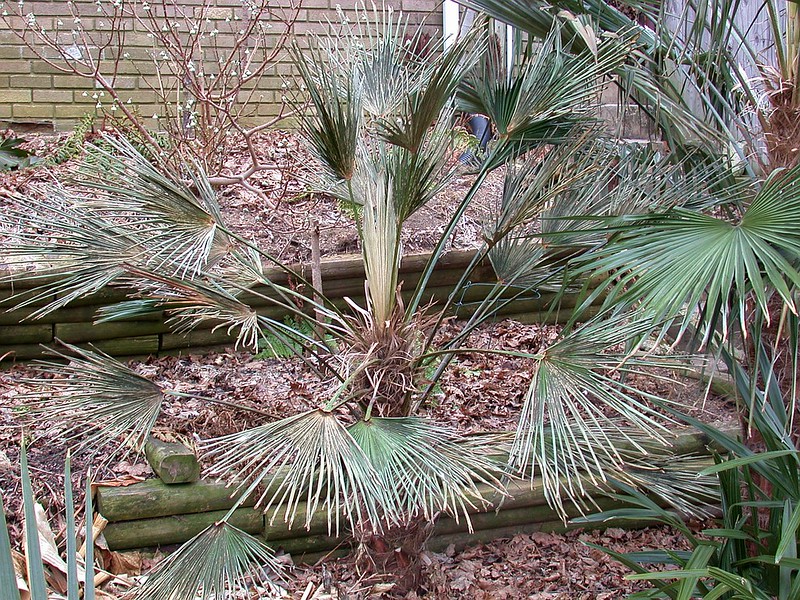
 Trachycarpus wagnerianus
 after our coldest winter in 20 years
Just as many growers of hardy palms are wondering whether our palms will survive our coldest winter in 20 years, and whether it's even worth growing them, I came across this in the
Plant Delights Nursery February 2014 e-newsletter:
Speaking of weather, winter 2013/2014 has been quite an event in many parts of the country, with temperatures finally returning to more "normal" winter levels. We've amusingly watched the last fifteen years as zone creep, aka: zone denial, has taken hold of much of America. It's been fascinating to observe how quickly peoples' memories of hard winters fade when they are only a couple of years removed. Some gardeners have recently admitted being lulled into a false sense of security by the constant media drumroll that our climate has dramatically warmed forever.
Gardeners in Zone 4 or 5 have a few Zone 7 winters where the winter low temperatures don't drop below 0 degrees F, and all of a sudden they decide that Zone 7 plants will actually survive in Zone 4 and 5. It's not uncommon these days to find less than reputable online nurseries listing plants like the hardy banana, Musa basjoo, as hardy to Zone 4 and 5, which is pure insanity. Windmill palms, which we consider marginally hardy for us here in Zone 7b, have now been planted throughout the mid-Atlantic states and even into parts of the Midwest. Because of the recent mild winters, some windmill palms have actually achieved good size before this winter's reality check. My friend Al Hirsch recently reminded folks on one of the hardy palm groups that he had actually freeze-tested windmill palms in the lab, and 5 degrees F was their low temperature tolerance...except for some of the hardier forms. Just because we've had a string of mild winters doesn't mean the winter temperature tolerance of plants change.
Tony
Avent is a global warming skeptic, and I disagree with him
on that subject (and one cold winter doesn't disprove global warming!). But I
agree with his main point here: many people have been fooled into thinking
certain plants are hardier than they really are, because we've had some
unusually warm winters for the last decade or more. I've seen claims that Musa basjoo is hardy to zone 4, and that windmill palms (Trachycarpus fortunei) are perfectly hardy in zone 7, but pretty much
anything is "hardy" with a warm enough winter, or if you provide enough protection.
I don't think anybody is suggesting we should stop growing hardy palms or subtropicals, or anything that might be marginally hardy. I'm certainly not, and I don't think Tony Avent is either, as he makes a lot of money from selling them to us! But we shouldn't expect (or pretend) plants to be hardier than they really are. Winters like this one
do happen periodically, they
will kill (or severely damage) marginally hardy plants, and for those of us in zone 7, windmill palms are among those marginally hardy plants.
My own attitude has always been that it's fun to grow plants like this and we should do it if we want to! But we should go into it with realistic expectations, and should expect to either protect or lose our plants when winters like this one come around. And we need to communicate those limitations and expectations when we advise or encourage people to grow plants like this.
So are all of our
windmill palms in the Washington, DC area dead? I don't think so. It's still too early to be sure, but I'm willing to bet that at least a few of the local palms, especially those planted in sheltered locations, will pull through. Many of us are growing palms from reputedly extra-hardy strains, so it will be interesting to see if that makes any difference. And regarding Al Hirsh's work, he was
testing temperatures that are lethal to leaf
tissue under laboratory conditions; whether those same temperatures would kill the same palm growing outdoors is another matter, certainly tied directly to the duration of the low
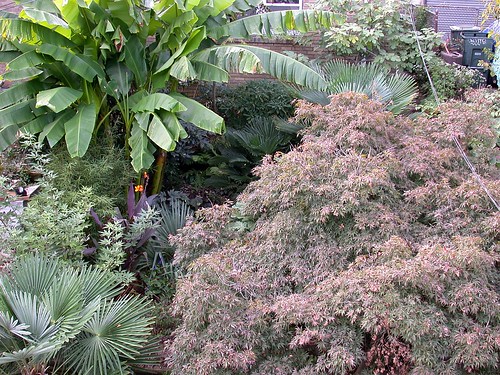
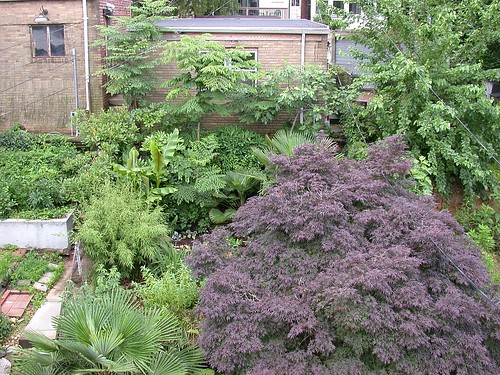
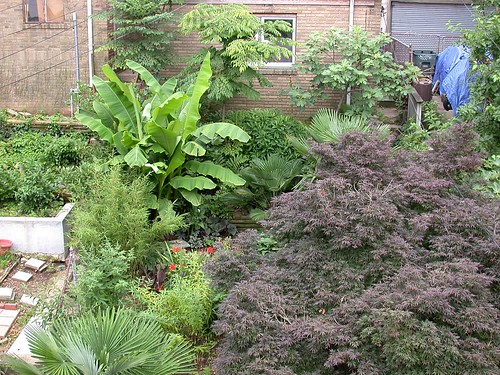
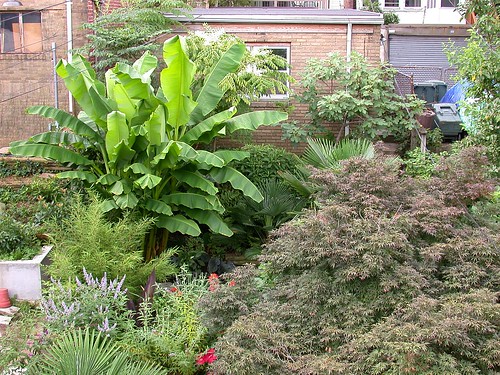
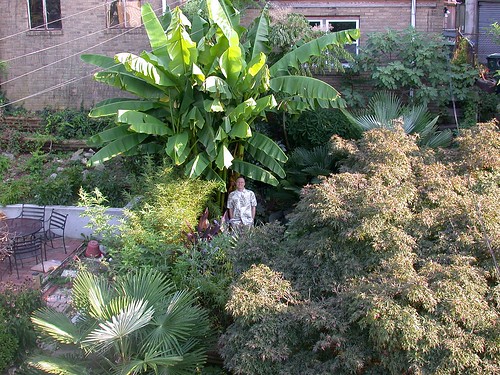
temperatures, which affects how deeply cold penetrates into the trunk, where the meristem (growing point) is deeply buried. Windmill palms are famous for bouncing back after suffering massive damage from winter freezes, so no matter how bad those palms may look this spring, don't give up hope! Doesn't a view like this make it all worth it?
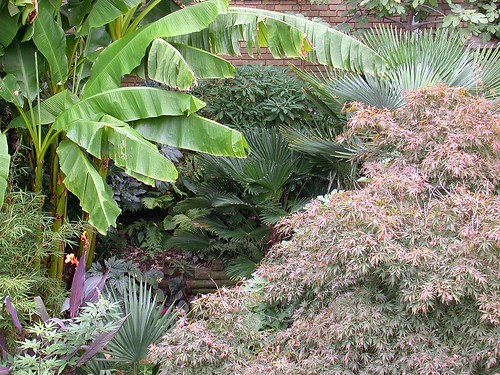
Garden, early October
Speaking
of weather, winter 2013/2014 has been quite an event in many parts of
the country, with temperatures finally returning to more "normal" winter
levels. We've amusingly watched the last fifteen years as zone creep,
aka: zone denial, has taken hold of much of America. It's been
fascinating to observe how quickly peoples' memories of hard winters
fade when they are only a couple of years removed. Some gardeners have
recently admitted being lulled into a false sense of security by the
constant media drumroll that our climate has dramatically warmed
forever.
Gardeners in Zone 4 or 5 have a few Zone 7 winters where the winter
low temperatures don't drop below 0 degrees F, and all of a sudden they
decide that Zone 7 plants will actually survive in Zone 4 and 5. It's
not uncommon these days to find less than reputable online nurseries
listing plants like the hardy banana,
Musa basjoo, as hardy to Zone 4 and 5, which is pure insanity.
Windmill palms,
which we consider marginally hardy for us here in Zone 7b, have now
been planted throughout the mid-Atlantic states and even into parts of
the Midwest. Because of the recent mild winters, some windmill palms
have actually achieved good size before this winter's reality check. My
friend Al Hirsch recently reminded folks on one of the hardy palm groups
that he had actually freeze-tested windmill palms in the lab, and 5
degrees F was their low temperature tolerance...except for some of the
hardier forms. Just because we've had a string of mild winters doesn't
mean the winter temperature tolerance of plants change.
- See more at: http://www.plantdelights.com/index/page/static/subpage/Newsletter_2014February#sthash.Y8cauiMu.dpuf
Speaking
of weather, winter 2013/2014 has been quite an event in many parts of
the country, with temperatures finally returning to more "normal" winter
levels. We've amusingly watched the last fifteen years as zone creep,
aka: zone denial, has taken hold of much of America. It's been
fascinating to observe how quickly peoples' memories of hard winters
fade when they are only a couple of years removed. Some gardeners have
recently admitted being lulled into a false sense of security by the
constant media drumroll that our climate has dramatically warmed
forever.
Gardeners in Zone 4 or 5 have a few Zone 7 winters where the winter
low temperatures don't drop below 0 degrees F, and all of a sudden they
decide that Zone 7 plants will actually survive in Zone 4 and 5. It's
not uncommon these days to find less than reputable online nurseries
listing plants like the hardy banana,
Musa basjoo, as hardy to Zone 4 and 5, which is pure insanity.
Windmill palms,
which we consider marginally hardy for us here in Zone 7b, have now
been planted throughout the mid-Atlantic states and even into parts of
the Midwest. Because of the recent mild winters, some windmill palms
have actually achieved good size before this winter's reality check. My
friend Al Hirsch recently reminded folks on one of the hardy palm groups
that he had actually freeze-tested windmill palms in the lab, and 5
degrees F was their low temperature tolerance...except for some of the
hardier forms. Just because we've had a string of mild winters doesn't
mean the winter temperature tolerance of plants change.
- See more at: http://www.plantdelights.com/index/page/static/subpage/Newsletter_2014February#sthash.Y8cauiMu.dpuf
Speaking
of weather, winter 2013/2014 has been quite an event in many parts of
the country, with temperatures finally returning to more "normal" winter
levels. We've amusingly watched the last fifteen years as zone creep,
aka: zone denial, has taken hold of much of America. It's been
fascinating to observe how quickly peoples' memories of hard winters
fade when they are only a couple of years removed. Some gardeners have
recently admitted being lulled into a false sense of security by the
constant media drumroll that our climate has dramatically warmed
forever.
Gardeners in Zone 4 or 5 have a few Zone 7 winters where the winter
low temperatures don't drop below 0 degrees F, and all of a sudden they
decide that Zone 7 plants will actually survive in Zone 4 and 5. It's
not uncommon these days to find less than reputable online nurseries
listing plants like the hardy banana,
Musa basjoo, as hardy to Zone 4 and 5, which is pure insanity.
Windmill palms,
which we consider marginally hardy for us here in Zone 7b, have now
been planted throughout the mid-Atlantic states and even into parts of
the Midwest. Because of the recent mild winters, some windmill palms
have actually achieved good size before this winter's reality check. My
friend Al Hirsch recently reminded folks on one of the hardy palm groups
that he had actually freeze-tested windmill palms in the lab, and 5
degrees F was their low temperature tolerance...except for some of the
hardier forms. Just because we've had a string of mild winters doesn't
mean the winter temperature tolerance of plants change.
- See more at: http://www.plantdelights.com/index/page/static/subpage/Newsletter_2014February#sthash.Y8cauiMu.dpuf