Showing posts with label Bananas. Show all posts

Saturday, August 2, 2014

A midsummer miscellany

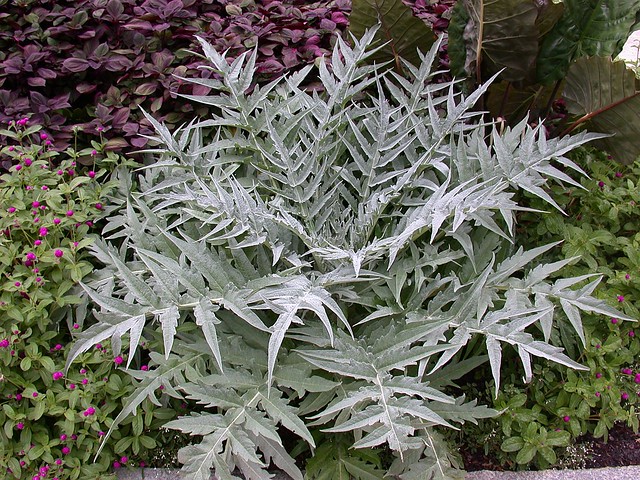
Cynara cardunculus
Cardoon (Cynara cardunculus), National Museum of Natural History gardens

I don't normally do a lot of walking in mid-summer, but we've had such uncharacteristically pleasant summer weather for the past several weeks that I can't use my usual excuse of heat and humidity to avoid a bit of exercise.  So come with me on a Friday evening as I walk from work in downtown Washington, DC to join my husband for dinner at a restaurant on 14th Street near Logan Circle.  This month marks 23 years since we moved here from a small town in upstate New York, so forgive me if I wax a bit nostalgic along the way!

Sunday, February 16, 2014

Why bother?

Fried waggie
Trachycarpus wagnerianus after our coldest winter in 20 years

Just as many growers of hardy palms are wondering whether our palms will survive our coldest winter in 20 years, and whether it's even worth growing them, I came across this in the Plant Delights Nursery February 2014 e-newsletter:
Speaking of weather, winter 2013/2014 has been quite an event in many parts of the country, with temperatures finally returning to more "normal" winter levels. We've amusingly watched the last fifteen years as zone creep, aka: zone denial, has taken hold of much of America. It's been fascinating to observe how quickly peoples' memories of hard winters fade when they are only a couple of years removed. Some gardeners have recently admitted being lulled into a false sense of security by the constant media drumroll that our climate has dramatically warmed forever.

Gardeners in Zone 4 or 5 have a few Zone 7 winters where the winter low temperatures don't drop below 0 degrees F, and all of a sudden they decide that Zone 7 plants will actually survive in Zone 4 and 5. It's not uncommon these days to find less than reputable online nurseries listing plants like the hardy banana, Musa basjoo, as hardy to Zone 4 and 5, which is pure insanity. Windmill palms, which we consider marginally hardy for us here in Zone 7b, have now been planted throughout the mid-Atlantic states and even into parts of the Midwest. Because of the recent mild winters, some windmill palms have actually achieved good size before this winter's reality check. My friend Al Hirsch recently reminded folks on one of the hardy palm groups that he had actually freeze-tested windmill palms in the lab, and 5 degrees F was their low temperature tolerance...except for some of the hardier forms. Just because we've had a string of mild winters doesn't mean the winter temperature tolerance of plants change.
Tony Avent is a global warming skeptic, and I disagree with him on that subject (and one cold winter doesn't disprove global warming!).   But I agree with his main point here: many people have been fooled into thinking certain plants are hardier than they really are, because we've had some unusually warm winters for the last decade or more.  I've seen claims that Musa basjoo is hardy to zone 4, and that windmill palms (Trachycarpus fortunei) are perfectly hardy in zone 7, but pretty much anything is "hardy" with a warm enough winter, or if you provide enough protection.

I don't think anybody is suggesting we should stop growing hardy palms or subtropicals, or anything that might be marginally hardy.  I'm certainly not, and I don't think Tony Avent is either, as he makes a lot of money from selling them to us!  But we shouldn't expect (or pretend) plants to be hardier than they really are.  Winters like this one do happen periodically, they will kill (or severely damage) marginally hardy plants, and for those of us in zone 7, windmill palms are among those marginally hardy plants.  

My own attitude has always been that it's fun to grow plants like this and we should do it if we want to!  But we should go into it with realistic expectations, and should expect to either protect or lose our plants when winters like this one come around.  And we need to communicate those limitations and expectations when we advise or encourage people to grow plants like this.

So are all of our windmill palms in the Washington, DC area dead?  I don't think so.  It's still too early to be sure, but I'm willing to bet that at least a few of the local palms, especially those planted in sheltered locations, will pull through.  Many of us are growing palms from reputedly extra-hardy strains, so it will be interesting to see if that makes any difference.  And regarding Al Hirsh's work, he was testing temperatures that are lethal to leaf tissue under laboratory conditions; whether those same temperatures would kill the same palm growing outdoors is another matter, certainly tied directly to the duration of the low temperatures, which affects how deeply cold penetrates into the trunk, where the meristem (growing point) is deeply buried.  Windmill palms are famous for bouncing back after suffering massive damage from winter freezes, so no matter how bad those palms may look this spring, don't give up hope!  Doesn't a view like this make it all worth it?

Garden
Garden, early October
Speaking of weather, winter 2013/2014 has been quite an event in many parts of the country, with temperatures finally returning to more "normal" winter levels. We've amusingly watched the last fifteen years as zone creep, aka: zone denial, has taken hold of much of America. It's been fascinating to observe how quickly peoples' memories of hard winters fade when they are only a couple of years removed. Some gardeners have recently admitted being lulled into a false sense of security by the constant media drumroll that our climate has dramatically warmed forever.
Gardeners in Zone 4 or 5 have a few Zone 7 winters where the winter low temperatures don't drop below 0 degrees F, and all of a sudden they decide that Zone 7 plants will actually survive in Zone 4 and 5. It's not uncommon these days to find less than reputable online nurseries listing plants like the hardy banana, Musa basjoo, as hardy to Zone 4 and 5, which is pure insanity. Windmill palms, which we consider marginally hardy for us here in Zone 7b, have now been planted throughout the mid-Atlantic states and even into parts of the Midwest. Because of the recent mild winters, some windmill palms have actually achieved good size before this winter's reality check. My friend Al Hirsch recently reminded folks on one of the hardy palm groups that he had actually freeze-tested windmill palms in the lab, and 5 degrees F was their low temperature tolerance...except for some of the hardier forms. Just because we've had a string of mild winters doesn't mean the winter temperature tolerance of plants change.
- See more at: http://www.plantdelights.com/index/page/static/subpage/Newsletter_2014February#sthash.Y8cauiMu.dpuf
Speaking of weather, winter 2013/2014 has been quite an event in many parts of the country, with temperatures finally returning to more "normal" winter levels. We've amusingly watched the last fifteen years as zone creep, aka: zone denial, has taken hold of much of America. It's been fascinating to observe how quickly peoples' memories of hard winters fade when they are only a couple of years removed. Some gardeners have recently admitted being lulled into a false sense of security by the constant media drumroll that our climate has dramatically warmed forever.
Gardeners in Zone 4 or 5 have a few Zone 7 winters where the winter low temperatures don't drop below 0 degrees F, and all of a sudden they decide that Zone 7 plants will actually survive in Zone 4 and 5. It's not uncommon these days to find less than reputable online nurseries listing plants like the hardy banana, Musa basjoo, as hardy to Zone 4 and 5, which is pure insanity. Windmill palms, which we consider marginally hardy for us here in Zone 7b, have now been planted throughout the mid-Atlantic states and even into parts of the Midwest. Because of the recent mild winters, some windmill palms have actually achieved good size before this winter's reality check. My friend Al Hirsch recently reminded folks on one of the hardy palm groups that he had actually freeze-tested windmill palms in the lab, and 5 degrees F was their low temperature tolerance...except for some of the hardier forms. Just because we've had a string of mild winters doesn't mean the winter temperature tolerance of plants change.
- See more at: http://www.plantdelights.com/index/page/static/subpage/Newsletter_2014February#sthash.Y8cauiMu.dpuf
Speaking of weather, winter 2013/2014 has been quite an event in many parts of the country, with temperatures finally returning to more "normal" winter levels. We've amusingly watched the last fifteen years as zone creep, aka: zone denial, has taken hold of much of America. It's been fascinating to observe how quickly peoples' memories of hard winters fade when they are only a couple of years removed. Some gardeners have recently admitted being lulled into a false sense of security by the constant media drumroll that our climate has dramatically warmed forever.
Gardeners in Zone 4 or 5 have a few Zone 7 winters where the winter low temperatures don't drop below 0 degrees F, and all of a sudden they decide that Zone 7 plants will actually survive in Zone 4 and 5. It's not uncommon these days to find less than reputable online nurseries listing plants like the hardy banana, Musa basjoo, as hardy to Zone 4 and 5, which is pure insanity. Windmill palms, which we consider marginally hardy for us here in Zone 7b, have now been planted throughout the mid-Atlantic states and even into parts of the Midwest. Because of the recent mild winters, some windmill palms have actually achieved good size before this winter's reality check. My friend Al Hirsch recently reminded folks on one of the hardy palm groups that he had actually freeze-tested windmill palms in the lab, and 5 degrees F was their low temperature tolerance...except for some of the hardier forms. Just because we've had a string of mild winters doesn't mean the winter temperature tolerance of plants change.
- See more at: http://www.plantdelights.com/index/page/static/subpage/Newsletter_2014February#sthash.Y8cauiMu.dpuf

Sunday, December 1, 2013

End of the Season

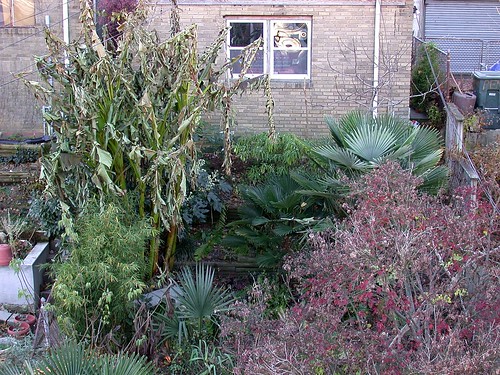
Post-freeze

The end of the growing season has arrived for my hardy banana (Musa basjoo) and the rest of my garden as well.  I took the above photo on my return to Washington, DC two weeks ago after being unexpectedly out of town for 9 days and found that there had been a hard freeze while I was gone.  This wasn't entirely unexpected; I usually get my first light frost in mid November and a hard freeze in mid to late November.  This is something that those of us growing tropical and subtropical plants in zone 7 have to confront sooner or later: they don't take well to freezing temperatures!  On the other hand, the first hard freeze sometimes comes late enough that many of my plants look good well into December.  But not this year!  Because the following days were forecast to bring colder-than-usual temperatures, with nights in the mid-20's, I spent the day before leaving to visit my family in Buffalo for Thanksgiving scrambling to mulch plants and bring in any potted plants I wanted to save.

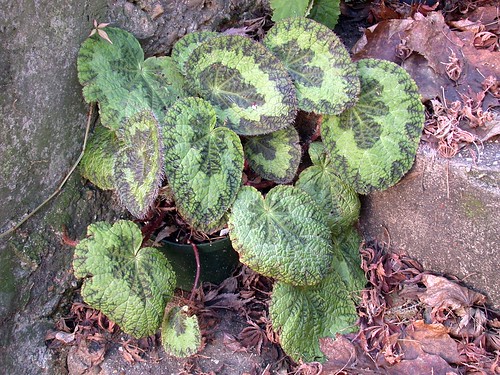
For most plants, putting the garden to bed simply means mulch, but I also have a lot of begonias in pots that need to be brought in.  These two photos show the dramatic effect of an overnight freeze on a potted plant of Begonia sizemoreae two years ago, when our first hard freeze didn't come until early December:

Begonia sizemoreae
Begonia sizemoreae, December 10, 2011

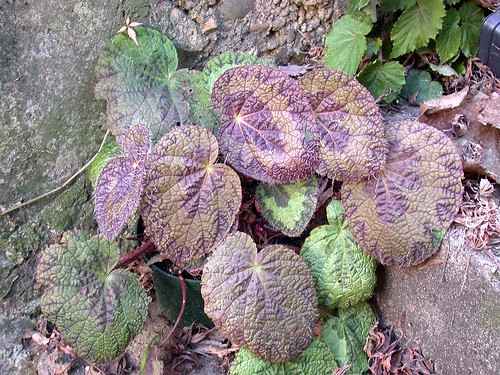
Begonia sizemoreae
Begonia sizemoreae, December 12, 2011

The second photo was taken the next morning while the plant was still frozen, and the discolored leaves turned to mush shortly afterwards.  Note that several of the leaves didn't freeze, and are still healthy and green.  When temperatures are near freezing a single degree makes all the difference, and even a little shelter--sometimes even the plant's own upper leaves--can prevent a plant from freezing.  But many of my other begonias are planted directly in the ground to test for hardiness, and sometime before the first frost I take cuttings of any I want to save so I can propagate them indoors over the winter as insurance:

Begonia leaves
Begonia leaves, ready for propagation

For my hardy palms, the only protection they receive is a thick mulch of autumn leaves around the base.  For my begonias and other marginally hardy herbaceous plants, I generally apply a mulch of 1-2 inches of Leafgro (a locally produced leaf compost) followed by another two or more inches of fallen leaves, which I gather in my own yard, from my neighbors' yards, and even in the alley behind the house.  When I peek under this mulch during the winter, I often find that the mulch itself is frozen solid but the soil just below it is not.  For many marginal plants, that little bit of mulch can make the difference between surviving and not surviving.

Finally, for my banana I use what I call my "big pile o' crap" method of protection.  Autumn leaves, the banana's own leaves, and anything else I cut down in the garden are thrown in a big pile around the base of the pseudostems.  In the past it has even included a Christmas tree.  It isn't pretty, but it does the job.  By spring much of it has already decomposed, and I leave it in place to help nourish the plant.

Forlorn Musa basjoo
Pile o' crap  method of protection

So after a hard freeze and a bit of cleanup, this is what I'm left to look at.  Fortunately the palms, the fatsia, and a clumping bamboo (Fargesia robusta) provide some green color all winter.
 
Early December

Thursday, October 17, 2013

Palm Progress, 2009-2013

Garden

I've always believed that starting small and allowing plants to establish themselves was more important than the instant results I could have gotten by planting larger specimens.  This was the case when I began planting hardy palms in my garden in 2002; most were planted as small seedlings (several of which I started from seed myself).  I want to find out how hardy these "hardy palms" really are so except for my dwarf windmill palms or "waggies" (Trachycarpus wagnerianus) when they were just starting out, none of my palms has been protected except for mulching.  Some of my hardy palms saw temperatures in the single digits in their early years, with the coldest being 6 degrees in February 2004, but winters since then have been warmer and it has been over 5 years since I've measured anything below 10 degrees in my yard.*

Friday, October 11, 2013

Then and Now (part 1)

yard1

This is what the back yard looked like from our back door when my partner (now husband!) Dan and I purchased the property in December 2000.  I knew that gardening on a slope, especially one with a northern exposure, would be a challenge but we had looked at over a hundred houses all over the city; this was one of the few that had both a decent-sized yard (by urban standards!) and off-street parking (that's our garage at the top of the hill), was in a good neighborhood, and (barely) within our price range.

This is how the garden looked that first spring, when I discovered all the uninspired plants the previous owners had planted (but you can see from pots in the foreground that I already had tropical ambitions!):

yard6

Having a garden for the first time after 10 years of apartment and condo living, I went a little bit nuts.  I cut down two plum trees, a japanese maple (for which Dan has never forgiven me), and removed most of the uninspiring perennials, replacing them with bananas, palms, and elephant ears.  I've had a lot of fun with this view over the years, although it definitely took a few years to really hit my stride!  This area is now mostly planted with annuals and tender tropicals and thus changes from year to year.  Here's how it has looked in previous years.

July 2003:

Lower garden late July

September 2004:

Back gardens, July

September 2009, when I went a little crazy with color (but keep an eye on that palm just barely peeking out from behind the elephant ears on the left):

Yard4

August 2011--yes, the palm grew that much in 2 years!  You'll also notice that my color palette has gotten a bit more subdued in recent years as I'm devoting more and more space to testing my seemannia and begonia hybrids, and let's face it, these just aren't as flashy as coleus and sweet potatoes:

garden

And finally October 2013, looking a little tired as the days shorten and the temperatures cool down (but note that the seemannias are still going strong); as the palm and remaining japanese maple have grown and filled in, I've been experimenting with shade-loving plants like begonias and gesneriads:

Garden, October 2013

Tuesday, October 8, 2013

Everybody Loves My Big Banana

Morning view

Pretty much the first thing anybody sees, or remarks upon, in photos of my garden is my banana.  The above photo shows how it looked this morning.  Yes, I have a big banana.

Musa basjoo is commonly known as the "hardy banana" because it is indeed quite hardy, surviving temperatures well below freezing.  In colder climates it acts like a giant perennial, the pseudostems freezing to the ground ever winter and springing back the following summer.  My plant has been in the ground since 2002 and the only protection I have ever given it is a modest pile of mulch, compost, autumn leaves, and/or whatever I happen to cut down in the garden in the fall.

You don't always realize just how fast some plants can grow until you take a few photos over the growing season and compare them.  The next photo shows my garden in early June; pay special attention to that little banana plant just barely visible in the upper left.  Yes, this is that very same banana at the beginning of the growing season:


After the rain

Now the fun part: here's the same scene in late June just 3 weeks later:

Garden, late June


And 3 weeks after that:

Garden

If it had stopped there I would have been happy!  The banana is a bit problematic in a small garden as it takes up an awful lot of valuable real estate, and tends to shade out surrounding plants.  Last year I fertilized it only once, in early spring; this year I didn't fertilize it at all, hoping to keep it on the small side.  So much for that!  I often see recommendations to feed bananas heavily but as it turns out, fertilizer isn't nearly as important as establishment, good soil, and adequate water when it comes to growing big bananas.

One final note: the leaves of Musa basjoo are rather thin and shred easily in the wind.  As you can see in the first photo up above, late summer storms can make a mess of the leaves.  So if you plant one, try to site it where it won't be exposed to wind.

Garden, late August


A refuge in the city

One of the challenges of gardening in a city is creating a sense of privacy.  This little bench in the center of my garden is completely invisible from any of the neighboring properties, thanks to careful placement of various plants.  It's a nice place to sit on a summer day, surrounded by palms and begonias and shaded by the hardy banana (Musa basjoo), except for the mosquitoes!


Welcome to DCTropics


I'm a botanist and gardener in Washington, DC.  As a botanist, my research specialty is the plant family Gesneriaceae and I have authored or co-authored several papers on subject (although my current duties are primarily collections & data management).  I work almost exclusively with pressed, dried, brown, and quite dead plants so when I come home I want to see something green and growing!  My horticultural interests are eclectic and wide-ranging and include gesneriads, begonias, hardy palms, and just about anything else that's tropical or exotic. I've also been an amateur plant breeder for over 25 years and have produced numerous cultivars in the gesneriad genera Sinningia, Primulina (formerly Chirita), Kohleria, and Seemannia (formerly Gloxinia) as well as a smattering of others, including some intergenerics.  In the last few years my interests have turned more towards Begonia with the primary goal of producing hardy begonia hybrids.

I've always been interested in growing unusual and exotic plants, and particularly "zone-pushing", testing the limits of plants that may or should be hardy in my region (USDA hardiness zone zone 7a/b).  I’m the organizer/admin of two online gardening groups, DCTropics (Yahoo) and MidAtlantic Tropics (Facebook).  I also have an extensive photo album on Flickr although you can still find some of my older photos in Photobucket.  Here are some of my most popular photos on Flickr (and don’t ask me how Flickr decides which are the most “interesting”).

Finally, here's a view of my garden as seen from our roof deck, taken just this morning (and yes, those are our neighbor's garbage cans; we live in an urban rowhouse with a very narrow lot and it's sometimes hard to hide things like that...):