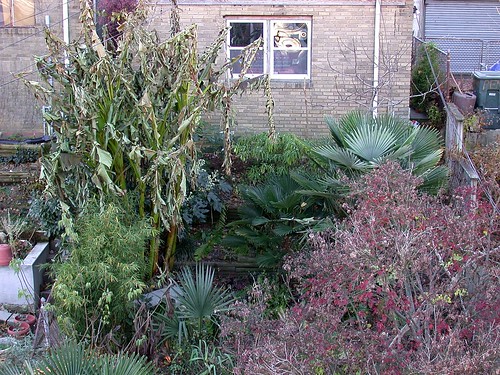
The end of the growing season has arrived for my
hardy banana (
Musa basjoo) and the rest of my garden as well. I took the above photo on my return to Washington, DC two weeks ago after being
unexpectedly out of town for 9 days and found that there had been a hard freeze while I was gone. This wasn't entirely unexpected; I usually get my first light frost in mid November and a hard freeze in mid to late November. This is something that those of us growing tropical and subtropical
plants in zone 7 have to confront sooner or later: they don't take well to
freezing temperatures! On the other hand, the first hard freeze sometimes comes late enough that many of my plants look good well into December. But not this year! Because the following days were forecast to bring colder-than-usual temperatures, with nights in the mid-20's, I spent the day before leaving to
visit my family in Buffalo for Thanksgiving scrambling to mulch plants and bring in any potted plants I wanted to save.
For most plants, putting the garden to bed simply means mulch, but I also have a lot of begonias in pots that need to be brought in. These two photos show the dramatic effect of an overnight freeze on a potted plant of
Begonia sizemoreae two years ago, when our first hard freeze didn't come until early December:
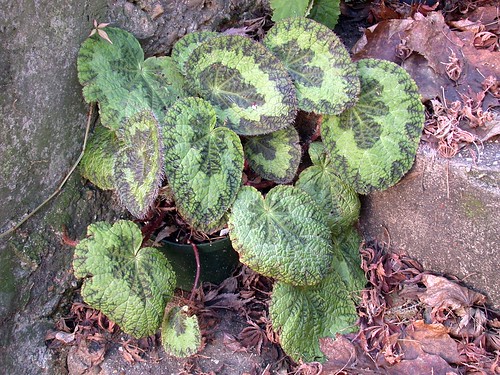 Begonia sizemoreae
, December 10, 2011
 Begonia sizemoreae
, December 12, 2011
The second photo was taken the next morning while the plant was still frozen, and the discolored leaves turned to mush shortly afterwards. Note that several of the leaves didn't freeze, and are still healthy and green. When temperatures are near freezing a single degree makes all the difference, and even a little shelter--sometimes even the plant's own upper leaves--can prevent a plant from freezing. But many of my other begonias are planted directly in the ground to test for hardiness, and sometime before the first frost I take cuttings of any I want to save so I can propagate them indoors over the winter as insurance:

Begonia leaves, ready for propagation
For my hardy palms, the only protection they receive is a thick mulch of autumn leaves around the base. For my begonias and other marginally hardy herbaceous plants, I generally apply a mulch of 1-2 inches of
Leafgro (a locally produced leaf compost) followed by another two or more inches of fallen leaves, which I gather in my own yard, from my neighbors' yards, and even in the alley behind the house. When I peek under this mulch during the winter, I often find that the mulch itself is frozen solid but the soil just below it is not. For many marginal plants, that little bit of mulch can make the difference between surviving and not surviving.
Finally, for my banana I use what I call my "big pile o' crap" method of protection. Autumn leaves, the banana's own leaves, and anything else I cut down in the garden are thrown in a big pile around the base of the pseudostems. In the past it has even included a Christmas tree. It isn't pretty, but it does the job. By spring much of it has
already decomposed, and I leave it in place to help nourish the plant.

Pile o' crap method of protection
So after a hard freeze and a bit of cleanup, this is what I'm left to look at. Fortunately the palms, the
fatsia, and a clumping bamboo (
Fargesia robusta) provide some green color all winter.